

PROXWELL AT H3IT 2026
From Data Exchange to Care Execution
Data exchange is necessary but insufficient for care execution at home. At H3IT 2026, Proxwell will present a workflow interoperability model for turning care intentions into observable coordinated work.
H3IT 2026 • Washington, D.C. • October 27, 2026 • Practice Track • Presentation Session I
The home is not a small hospital.
Structured encounters come with defined roles, formal workflows and handoffs, documentation systems, escalation paths, and embedded timing rules.
When continuing care work moves home, those structures do not automatically follow. Responsibility is distributed across family, paid caregivers, and other helpers; daily life shapes timing; and people assemble fragmented tools around household routines.
The problem is not a failure of families. It is an infrastructure gap: consequential care work moves home while equivalent execution infrastructure often does not.

Information everywhere is not a shared execution state.
Information Everywhere
Texts, calls, family chat, memory, verbal updates, paper notes, calendar reminders, informal handoffs.
No Shared Execution State
Information can exist without anything consistently binding it to responsibility, timing, provenance, status, and closure.
5 Operating Questions
Who is responsible? When is action expected? What actually happened? What remains open? Who must follow through?
Workflow interoperability turns information into a shared, observable execution state.

WASHINGTON, D.C. - GEORGE WASHINGTON UNIVERSITY
Proxwell at H3IT 2026 | Practice
From Data Exchange to Care Execution: Building Workflow Interoperability for Care at Home
Presented by
Laura P. McLafferty, MD | John McLeod, MBA | Lawrence J. Choi
Presentation Session I • October 27, 2026 • Washington, D.C.
Session window: 9:30 AM to 11:30 AM
H3IT 2026 Details
Official program: https://events.h3it.org/
Conference home page: https://h3it.org/
Registration: https://www.eventbrite.com/e/h3it-2026-presented-by-kno2-registration-1997011283507
HEAR ABOUT OUR APPROACH TO CARE EXECUTION
The missing execution layer has four jobs.
TASK INSTANTIATION - Converts care intentions into executable work with permitted actors, timing, and state.
RESPONSIBILITY WINDOWS - Establishes who owns coverage during a defined period and makes handoff timing visible.
CARE-CONTEXT SIGNAL CAPTURE - Preserves scheduled and unscheduled observations, measurements, actions, and communication in context.
SIGNAL REVIEW AND ACCOUNTABILITY - Exposes execution states so work can be reviewed, followed through, and closed.
Across every component: Role authority governs. Temporal logic situates. Provenance records.
2023
2023 | FRAMEWORK DEVELOPMENT
From July through December 2023, the team synthesized recurring home-execution problems across mainstream reporting, government, nonprofit, foundation, professional, and peer-reviewed sources, with input from 97 lay family participants, 10 physicians, and 25 allied health professionals.
2024-25
2024-2025 | REFINEMENT AND OPERATIONAL TRANSLATION
Family and professional feedback refined proof-of-concept workflows in 2024. In 2025, the conceptual work was translated into operating software workflow.
2026
2026 | OBSERVATIONAL IMPLEMENTATION ANALYSIS
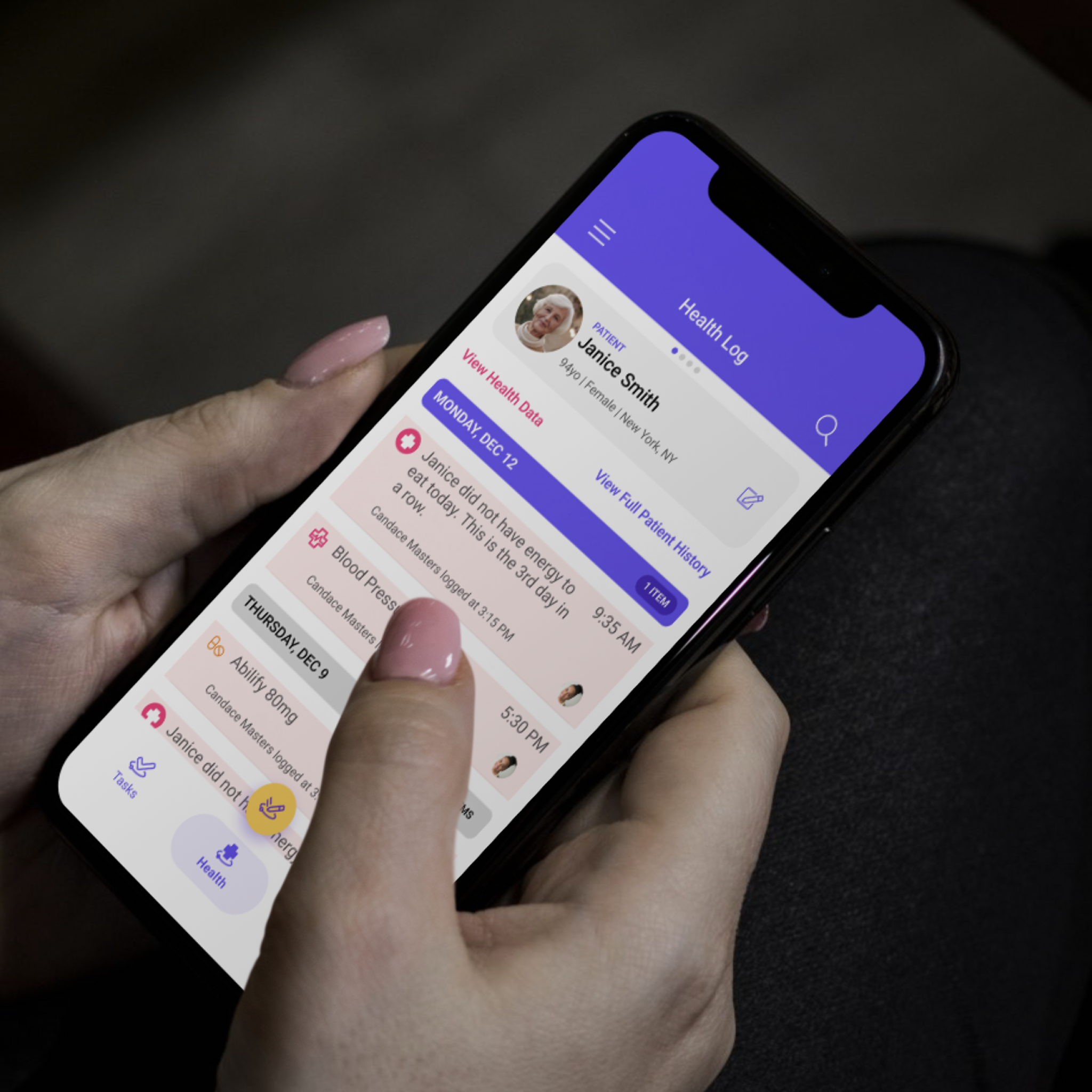
Because home-care cases were heterogeneous and family permissioning was inconsistent, the team conducted a deep review of one permissioned, data-rich complex aging-in-place case, examining documentary artifacts and scheduled-task dispositions from March through July 2026.
Practice Track case signal


In the one permissioned case analyzed for H3IT, missed scheduled tasks were 20.2% during early use and 11.7% during established use. Completion was 79.8% and 88.3%, respectively.
The strongest resolved signal appeared in non-medication activities, where the missed rate was 24.7% during early use and 13.3% during established use.
Evidence boundary: this is a single-patient observational comparison. It supports model instantiation, observability, and measurement feasibility. It does not establish causality or population-level efficacy.
Further Proxwell reading
AI's Real Future Lies Between Advice and Execution - https://www.getproxwell.com/blog/the-real-future-of-ai-lies-in-the-gap-between-advice-and-execution
The Home Does Not Need More Goodwill. It Needs More Structure. - https://www.getproxwell.com/blog/the-home-does-not-need-more-goodwill-it-needs-more-structure
Bundled Payments Are Moving Accountability Into the Least Structured Setting in Health Care - https://www.getproxwell.com/blog/bundled-payments-are-moving-accountability-into-the-least-structured-setting-in-health-care
Care at home does not succeed because information arrives.
It succeeds when distributed human work becomes executable, observable, and accountable. If your organization is working on home care, home health, post-acute care, care coordination, interoperability, or technology that has to function beyond institutional walls, we would welcome a conversation.